How To Remove a 201 Bobbin Case

Taking the bobbin case out of a 201-2 is simple. Dead simple. These instructions look long, but you'll only have to follow along with them once or twice. After you do this a couple times, it'll be as easy as removing the gas cap on your car.

You will need the correct tools: A screwdriver with good bits, and the small, silver Singer screwdriver (pictured up top) that came with many machines.

If you don't have the Singer screwdriver, find the tiniest flathead (slotted) screwdriver you can find. To see if it's the right size, take out a dollar bill. See those letters at the top of the bill that say FEDERAL RESERVE NOTE? The width of the screwdriver blade's edge should be about the same height as those letters, as seen in the photo below. If it's much smaller or bigger than the letters, it will probably not work. (Update: If you don't have U.S. money to check with, click here.)


People probably find 201 bobbin case removal difficult because they don't know what the separate parts look like. When I looked down at the hook assembly for the first time, I couldn't tell where one part ended and another began, so I didn't know what the heck I was supposed to be removing, and the drawing in the Adjuster's Manual was too small for me to make anything out. So here I'll use huge pictures to explain. Note that in the photos, I have the machine pointed towards me.

The first part of the hook assembly you are going to be removing looks like this:


For simplicity's sake we'll call it the Retaining Ring. (If you ever need to order this part from a supplier, its official name is the Rotating Hook Bobbin Case Retaining Ring.)

The Retaining Ring is held in place on the assembly by two little clips on either side, like two hands reaching up to hold the brim of your cowboy hat onto your head on either side. The Retaining Ring holds the bobbin case in place, and after we remove it, the bobbin case can be lifted out.

Once you get good at doing this, you won't need to remove the needleplate, feed dogs and position plate (though you may want to for cleaning). But we'll remove it in this tutorial to make things easier.

I've removed the needle and presser foot for visual clarity.


Next I remove the slide plate and the bobbin.


This machine was just acquired and the previous owner has left a thread tangle. Pull every last bit of thread out.

Then remove the needleplate and feed dogs. If you need instructions for how to do this, click here.


Now you see this bar, called the  Rotating Hook Bobbin Case Position Plate.


Undo the two screws and take it off. (Again, you won't need to once you get good at this, but it will give us more room the first time.)


Now we're ready to get down to business. The Retaining Ring has a butt end, as we saw in an earlier photo. Look for it and recognize it. Also look for and recognize the two clips. If you don't see these parts, rotate the handwheel until you do.


The clip near the butt end has a little notch next to it. In the photo below, I've rotated the handwheel to move everything around so you can see it better.


Stick the blade of the Singer screwdriver in that notch.


Then rotate the screwdriver clockwise, just 90 degrees, while pressing the screwdriver gently downwards.


Once you've rotated the screwdriver 90 degrees and pressed down, the clip moves outward. It should look like this:


Now take the little screwdriver, and stick it under the edge of the butt end of the Retaining Ring, like this:


Here's what it looks like from a side view:


Next GENTLY push down on your end of the screwdriver, using it as a lever, so the blade end of the screwdriver goes up. Be gentle, you don't have to move the screwdriver very much at all. You are NOT trying to pry the Ring off, just moving it up a millimeter or two to free itself from the clip. With gentle pressure it will free itself from the clip with a soft click.


Now the Retaining Ring is sitting on top of the clip, not under it anymore.


Almost there. Now, with your right hand, reach over to the back of the machine and hold the balance wheel steady, so that it doesn't move.


With your thumb and forefinger of your left hand, grasp the Retaining Ring.


Then just rotate the Retaining Ring counterclockwise ("to the left"), very slightly. It will free itself from the other clip with a quiet click.


That's it, now you can take it off. (You can do it with your fingers, but I removed it with tweezers here because my fingers were too big in the photo for you to see the Ring.)


Now the bobbin case can be lifted out, easy peasy.


Next, all you've gotta do is clean out the race with a Q-Tip. Have fun!


When you're ready for the next steps, click over to How to remove the actual rotating hook, especially if there's a lot of junk under there that needs cleaning out; then check out How to get everything back together.

Screwdrivers, Part 5: Bits That Fit a 201-2


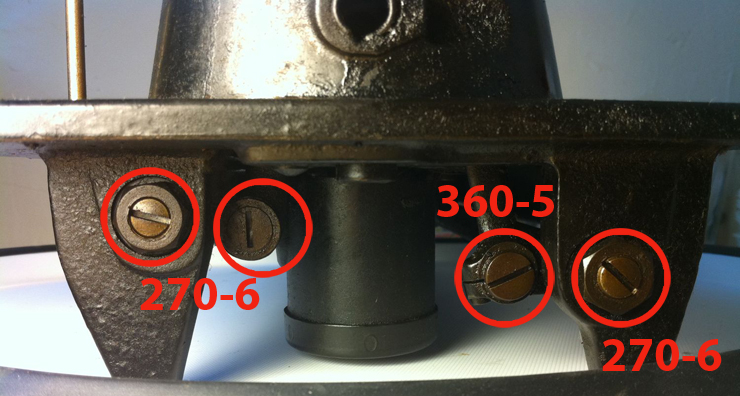
Above and below are photos of screws you might need to get to on a Singer 201-2, and the corresponding Brownells screwdriver bit number that will fit that screw. You can then order the bits you need at this link to Brownell's website (at $2.99 a pop).

I'm not sure if this is helpful to anyone, but if it is and there's a high enough demand, I can do a similar "Bits That Fit" for a 221 Featherweight, a 206 or a 99.

I've made these photos pretty big, because on other instructional websites I've seen I always find the photos too small. If these are difficult for you to load, too big, or not big enough, please let me know in the comments.


Screwdrivers, Part 4: Bits That Will Fit a 15-91


If you've already got some assorted screwdriver bits that will fit parts of your Singers, and a bit-holding screwdriver handle, you don't need to purchase an entire set. You can save a couple bucks by ordering just the individual bits you need from a company like Brownells. So what I've done here is photographed the various parts of a 15-91 and labeled, below, which Brownells bit will fit it. (I figured looking at photos of the screws in question is easier than figuring out the name of the screw and checking that against a list.)

You can then order the bits you need at this link to Brownell's website. They're $2.99 a pop. Happy fixing!


("Small Singer Screwdriver" refers to the tiny silver-handled one that you use to adjust your bobbin tension.)


This brush-cap screw is made from Bakelite, not metal. Do not overtighten or it will crack!


You can assume symmetry here for the unlabeled screws.


Go on to Screwdrivers, Part 5: Bits That Fit a 201-2

Screwdrivers, Part 3: Which Set Do I (or Don't I) Need?


As I mentioned earlier, a good set of hollow-ground screwdriver bits is a must if you're going to work on your machine. You can choose to buy an entire set or buy the bits individually, which may work out cheaper depending on your needs. If you are a gun-owning household, you may already have a set lying around the house, as gunsmithing screwdrivers are hollow-ground. (By the way, the hexagonal shafts of screwdriver bits are standardized, so you can use any bit with any other manufacturer's handle.)

Here I'll review the three sets I have experience with, and point out some purchasing errors I made, in hopes you won't do the same. If you already have some screwdriver bits that fit some Singer parts, do not buy an entirely new set, that's a waste of money. Just wait until the next entry, where I'll cover some individual bits you can add to the ones you have. That will be a lot cheaper.


B-Square


My first purchase was this B-Square screwdriver set. I got it for $33 at a local gun store, it was the only set they had. I quickly regretted buying it as most of the bit blades are too thin for most Singer screws. That being said, the handle included in the set is my favorite of all I own:


The long shaft provides good torque, and it's my go-to handle for removing tough screws (like the thick ones that attach the potted motor of a 201-2 or 15-91 to the body). I use it with non-B-Square bits.

If you own a wide variety of sewing machines (or guns) you'll be working on, perhaps B-Square's thin-blade bits will work for you, but in practice I hardly use any of them. I wouldn't recommend this set if you're working exclusively on Singers.

Brownells


The second gunsmithing tool company I looked into was Brownells. Having learned my lesson by wasting my money on the B-Square set filled with bits I didn't need, I painstakingly measured a bunch of Singer screw slots with a caliper to determine the size of bits I would need. I then ordered just the ones I needed at $2.99 per bit, and ordered a short handle and case to carry them all. Brownells also sells screwdriver sets, but I found that none of them had a high percentage of bits that I needed.

The Brownells bits are my favorite of all I own. They're one-and-a-half inches long, making them both easy to handle and useable as mini-screwdrivers in their own right, which I really like.


This short handle I ordered from them (#080-089-005) is good for spaces where the long B Square handle won't fit, like when you need to remove a machine's hinge screws from a case or cabinet.


The short handle is great for getting into cabinets and cases.

By the way I mis-measured some screws and had to re-order some different bits, so I wasted about $20. To help you avoid this problem, I'll cover exactly which Brownells bits are good for Singers in the next entry (it's gonna take a lot of photos).

Chapman

If you don't want to bother with purchasing individual bits, Chapman Manufacturing Company's 9600 set is the best value for the money. For about $29 you get a good range of 12 slotted-head bits (and some other shapes I never use), the ratchet, and a handle with extension. With just these 12 bits I'm able to remove every screw I've tried on a Singer 15-91 and 201-2. The extendable handle is useful because you can make it a long or short screwdriver, and as I described in an earlier entry, the ratchet is great for taking off the needleplate and feed dogs.


While the Chapman bits are not as long as the Brownells bits, they are also designed to be used as mini-screwdrivers, with a knurled grip area at the top.


The Chapman set is the one used and recommended by Ray White, the sewing machine repairperson whose class I recently had the pleasure of taking. He mentioned that he had heard some reports of people occasionally breaking these bits; in the event of a stuck screw, Chapman bits are designed to break before the screw does, but I have not experienced this myself.

You can mail-order the Chapman set (#K9600) from Ray White here.

You can also order it on Amazon at this link:


Conclusion

If I had to start over with screwdriver sets, knowing what I know now, I'd probably just buy the Chapman set and save the rest of my money. I've spent over $100 to find out what works, and while I can't get that money back, I can at least pass this information on. You should be able to get what you need for about $30, less if you already have some bits or handles to start with.

I like the Brownells for their heft but the Chapmans serve equally well and cost less. I find the B-Square bits, in addition to not fitting Singer screws well, so short that they're difficult to handle. They're so stubby I often have trouble getting them out of the magnetic handles and sometimes I have to use pliers.


Another thing you may want to consider is the size of the cases. For example, if you're going to be the resident repairperson for your quilting group, the Chapman case is the smallest: For guys, it will fit in a jacket pocket; for gals, it will fit in a purse.


Full Disclosure


Lastly, I should mention the Amazon link up above. Whenever you see me put up an Amazon link, that's because I signed up for their affiliates program. That means if you click on the link and actually buy the product, Amazon gives me a few cents. Because this is the case, I don't want you to think I'll push junky products on this blog and try to trick you into buying them. I'll only give honest reviews of products I have direct experience with, and if Amazon sells them, I'll put up a link. Believe you me, any money that happens to trickle in from Amazon is going back into sewing machine repair research.


Go on to Screwdrivers, Part 4: Bits That Will Fit a 15-91